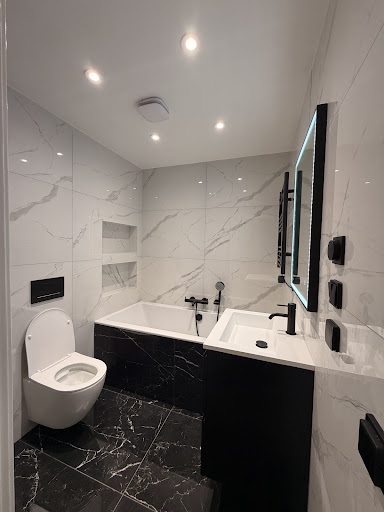
Zone 0 — in het bad zelf
The volume inside the bath rim or shower tray. Here only SELV is allowed: maximum 12 volts AC, with the supply outside the zones. IP rating IPX7, so resistant to immersion.
Bathroom electrics in Amsterdam from € 685 including 21% VAT. The NEN 1010 zone rules decide which fitting, which socket and which IP rating is permitted at which distance from the bath. Use the zone checker below.
Pick what you want to fit and which zone it sits in. We answer according to the NEN 1010 zone layout, with the required IP rating. This is guidance, not a design — the final assessment is done on site.
Choose on the left what you want to install and which zone it goes in.
Guidance based on the NEN 1010 zone layout. The final assessment depends on the real dimensions in your bathroom and is done on site.
The zone layout is about one question: how likely is water to reach it, and how likely are you to touch that thing while wet. The closer to the bath, the stricter.
The volume inside the bath rim or shower tray. Here only SELV is allowed: maximum 12 volts AC, with the supply outside the zones. IP rating IPX7, so resistant to immersion.
The space above zone 0 up to 2.25 metres height. Luminaires with at least IPX4 are allowed here, as are an electric boiler or a whirlpool pump. Sockets are not. For a shower without a tray, zone 1 is measured from the shower head.
A band of sixty centimetres around zone 1, to the same height of 2.25 metres. IPX4 luminaires are allowed, mirror lighting is allowed, ventilation is allowed. An ordinary socket is not — only a shaver outlet with isolating transformer.
The rest of the room. Here an ordinary socket is allowed, provided the whole bathroom circuit is protected by a 30 mA RCD. That last point is not advice but a requirement, and it applies to the whole bathroom.
All metal parts in the bathroom you can touch at once — water pipe, drain, radiator, bath — are bonded to each other and to earth. That way no voltage difference can arise between the tap and the bath.
The first digit is about dust, the second about water. IPX4 means resistant to splashing from any direction. IPX5 is a water jet, IPX7 immersion. Every fitting shows it; we check it at install against the zone it sits in.
A bathroom without bath or shower — a toilet with only a basin — has no zones. There an ordinary socket may go anywhere, provided it is on a 30 mA RCD. The misconception runs the other way: many people think no socket is allowed anywhere in the bathroom. Outside the zones it is fine, and that is exactly where the washing machine belongs.
For a bathroom of four to six square metres, electric underfloor heating is almost always the better choice over water. Installation costs are a fraction, you need no manifold, and the floor is warm within twenty minutes instead of two hours.
€ 110 per square metre including the mat, floor sensor, programmable thermostat and connection on a dedicated circuit. For a five-square-metre bathroom that is about € 700. The floor finish itself is not included — the mat goes under the tile adhesive, so tiling continues as normal.
Not under the bath, not under a fixed shower tray and not under furniture on the floor. The mat needs air circulation to shed heat; if it is enclosed it eventually fails. That means of five square metres of bathroom you heat three to four in practice — and that is enough.
The thermostat measures floor temperature via a sensor that sits between the heating wires in a flexible conduit. That conduit exists so the sensor can be replaced in ten years without lifting the tiles. Installers who lay the sensor loose in the adhesive to save time cause a demolition job five years later. We always lay it in a conduit, with a bend large enough to pull a new sensor through.
The mat goes in after the floor is poured and levelled, and before the tiler arrives. We measure mat resistance three times: on delivery, after unrolling and after tiling. That way we know exactly when damage occurred — and that is the difference between an argument and a repair.
Underfloor heating gets its own circuit with RCD protection. The thermostat sits outside the zones, preferably next to the light switch by the door. Programmable is worth it: a bathroom that is warm at half past six and off again at nine costs a fraction of a floor that runs all day.
For a bathroom up to about eight square metres electric almost always wins on install cost and speed. For a larger room, or if you already have a boiler manifold nearby and the floor is thick enough, water can work out cheaper in use. We say honestly which of the two fits your situation — even if that is the variant we do not supply.
The classic problem: a spot in the ceiling above the mirror. It lights your forehead and puts your eyes in shadow. For shaving, make-up or checking a cut that is exactly wrong.
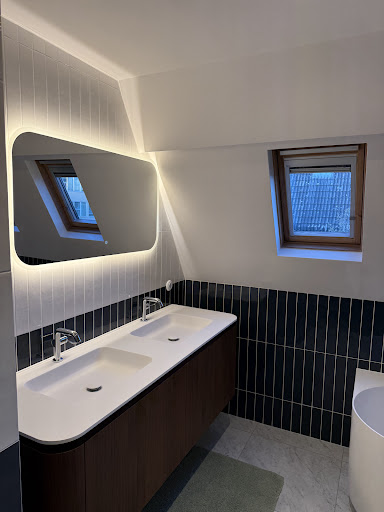
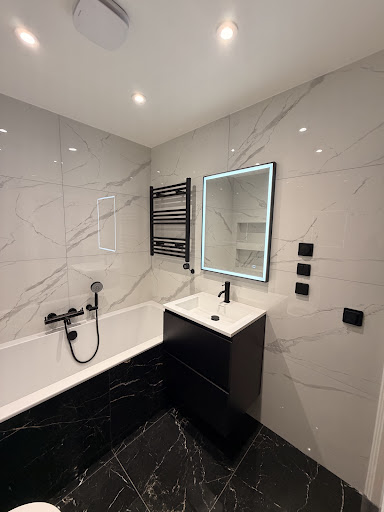
The neat solution: light that comes from the mirror itself, at eye height and from the front. Needs a connection behind the mirror at the right height — so the mirror size must be known before we pull the cable. IPX4 and on the bathroom circuit with RCD.
Two luminaires left and right at about 1.70 m give the most even face light. Often in zone 2, so IPX4. Works better than one luminaire above the mirror, and looks calmer.
Recessed spots with IPX4 where they fall inside the zones. Allow three to four spots in a five-square-metre bathroom, at 3,000 K — warmer light makes it harder to judge colour when shaving or putting on make-up.
An ordinary wall switch is not allowed in zones 0, 1 or 2. In practice it therefore sits outside the bathroom, beside the door — or inside, but outside the zones. A ceiling pull cord is the classic solution in small bathrooms where no wall is outside the zones. And an occupancy sensor works less well in a bathroom than people hope: it no longer sees you when you lie still in the bath.
In Amsterdam homes with a windowless bathroom, a good fan is the difference between clean joints and black edges. The electrical part is small work; the switching choice makes the difference.
As high as possible and as far from the door as possible, so air is drawn through the whole room. In zones 1 and 2 with at least IPX4. Above the shower is allowed if the type is suitable — and that is on the type plate, not in the brochure.
A fan that extracts without make-up air does nothing. There must be a gap under the door of at least a centimetre, or a supply grille. This is the most common reason people think their fan is broken while it works fine.
Duct, façade grille and penetration belong to the same job. If we do the whole bathroom renovation, ventilation is one line item instead of three parties pointing at each other.
Including materials, labour, chasing and plaster-ready making good. You buy luminaires and mirrors yourself; we fit and connect them to the zone layout.
| Bathroom fully electric, to zone layout | per bathroom | € 685 – 1.250 |
|---|---|---|
| Bathroom incl. underfloor heating 5 m² | per bathroom | € 1.385 – 1.950 |
| Dedicated bathroom circuit with RCD protection | per circuit | € 265 |
| Bathroom equipotential bonding | per bathroom | € 145 |
| Bathroom handover inspection with measurement protocol | per bathroom | € 145 |
| Electric underfloor heating incl. thermostat | per m² | € 110 |
|---|---|---|
| Floor sensor and programmable thermostat separately | per room | € 195 |
| Connect an electric towel radiator | each | € 185 |
| Fit and commission an electric boiler | each | € 545 |
| Connect an instantaneous water heater | each | € 265 |
| Fit and connect an infrared panel | per paneel | € 165 |
| Fit and connect an IPX4 recessed spot | per spot | € 95 |
|---|---|---|
| Connect mirror lighting or an illuminated mirror | each | € 165 |
| Wandarmatuur IPX4 monteren | per luminaire | € 115 |
| Socket outside the zones | per punt | € 145 |
| Shaver outlet with isolating transformer | per punt | € 225 |
| Switch outside the zones or pull cord | per punt | € 85 |
| Dimmer matched to LED load | per dimmer | € 135 |
| Chasing in brick | per metre | € 17 |
| Bathroom fan with overrun | each | € 185 |
|---|---|---|
| Fan with humidity sensor | each | € 235 |
| Connect mechanical ventilation electrically | per system | € 465 |
| Connect and switch an MVHR unit | per unit | € 395 |
| Core drill for extract through the façade | per doorvoer | € 95 |
All amounts include materials, labour and 21% VAT, valid in 2026 for Amsterdam and surroundings. If we also do tiling, plastering and painting in the same bathroom, the plastering and painting part falls under 9% VAT and we split the invoice. Complete badkamerrenovatie →
Yes, but not everywhere. In zones 0, 1 and 2 an ordinary socket is not allowed. Outside the zones — further than sixty centimetres from the bath or shower, or higher than 2.25 metres — it is fine, provided the bathroom circuit is protected by a 30 mA RCD.
In zone 2 one exception is allowed: a shaver outlet with an isolating transformer. That is a separate fitting, not an ordinary socket, and it costs € 225. A bathroom without bath or shower — a toilet with a basin — has no zones at all.
Fully wiring a bathroom to the zone layout costs € 685 to € 1,250 including 21% VAT, depending on the number of points, lighting and chasing. That includes the dedicated circuit, cables, bonding, spots, mirror lighting, the fan and plaster-ready making good.
With five square metres of electric underfloor heating added you reach € 1,385 to € 1,950. The underfloor heating itself costs € 110 per square metre including mat, floor sensor, programmable thermostat and connection on a dedicated circuit.
An IP code has two digits: the first is about dust, the second about water. IPX4 means resistant to splashing from any direction; the X means dust is unspecified. IPX5 resists a water jet, IPX7 immersion.
In zones 1 and 2 IPX4 is the minimum for luminaires and fans. In zone 0 — in the bath itself — IPX7 applies and only SELV up to 12 volts is allowed. Outside the zones there are no special IP requirements. Every fitting shows the code; we check it at install against the zone it sits in.
Yes, provided the socket is outside the zones — further than sixty centimetres from bath or shower — and the circuit is protected by a 30 mA RCD. In practice that means the wall opposite the shower, or a niche.
What we often find is a washing machine on a two-pin socket without earth in a utility room or bathroom with a tiled floor. That is exactly the combination where a fault ends badly. Earth here is not a luxury but a requirement.
Not in zones 0, 1 or 2. In practice the switch therefore sits outside the bathroom by the door, or inside but outside the zones. In a small bathroom where no wall is outside the zones, a ceiling pull cord is the classic solution.
An occupancy sensor works less well in a bathroom than people hope: it no longer sees you when you lie still in the bath, and then the light goes out. Fine for a toilet; for a bathroom with a bath we do not recommend it.
For a bathroom up to about eight square metres, almost always. Installation costs are a fraction of wet systems, you need no manifold, and the floor is warm within twenty minutes instead of two hours. € 110 per square metre including mat, sensor, thermostat and connection.
One caveat: the mat does not go under the bath, under a fixed shower tray or under furniture on the floor — it needs air circulation. Of five square metres of bathroom you heat three to four in practice, and that is enough.
Bonding all metal parts you can touch at once — water pipe, drain, radiator, bath rim — to each other and to earth. That way no voltage difference can arise between, for example, the tap and the bath.
It is required and costs € 145 per bathroom. In old Amsterdam homes it is almost always missing, and it is one of the cheapest things you can do for bathroom safety.
After the old bathroom is out and the walls are bare, and before the tiler arrives. Then we run the cables, fit junction and back boxes in their final positions, and test while everything is still open.
The underfloor mat goes in after the floor is levelled and before tiling. We measure resistance three times — on delivery, after unrolling and after tiling — so if damage occurs it is clear when. Then we return once more for finishing: spots, mirror, fan and switches.
Yes. A bathroom wired to the NEN 1010 zone rules costs € 685 to € 1,250 including materials, labour, chasing, making good and 21% VAT, or € 1,385 to € 1,950 with five square metres of electric underfloor heating.
The zone rules are strict: nothing but 12 V SELV inside the bath, IPX4 minimum within 60 cm of it up to 2.25 m, no ordinary socket outlets in zones 0 to 2, and a 30 mA RCD on the whole bathroom circuit without exception. Use the zone checker at the top of this page, or send us a photo and we will tell you what is permitted where.

Send a floor plan or a few photos of your bathroom — then we say which points may go where and what it costs.
If you choose “as soon as possible”, we call within four hours during office hours. Outside those hours, the next morning.
You speak to someone who does the work and can already say on the phone what is going on and roughly what it costs.
Tell us which language you prefer and we will make sure the right colleague calls.
The home survey is free too, with no call-out fee. You are not committed to anything.
One photo of the open meter cupboard tells us more than ten minutes on the phone. We look at it free of charge and say honestly whether anything needs doing — even if the answer is “no”.
Send photo via WhatsAppEarthing and bonding, the lighting and sometimes the whole installation — below is what those cover separately.
The hub page with the price calculator, circuit check and the full price list of more than 180 rates.
Read moreHow to see that earth is missing, why it cannot wait and what it costs.
Read moreHow many spots per room, which colour temperature where and why your dimmer flickers.
Read moreRewire the whole home: cost per m², work sequence and lead time.
Read more