Questions we really get
Twenty questions, answered straight
Is the calculator price the price I will pay?
It is a guide price with a band of about twelve per cent, calculated with our real rates. After the survey we put a fixed price under it. In practice nine out of ten final quotations land inside that band; if one falls outside, we explain what caused it.
Why is carpentry 21 % VAT and painting 9 %?
Because the tax authority grants the reduced rate only to insulating, painting, plastering and wallpapering a home older than two years. Carpentry is not on that list. If your job also includes insulation or painting, we put those lines at 9 % separately — you see it in the breakdown.
Do you really charge double on Sunday?
On Sundays and public holidays we double the labour, not the material. It is not a trick: anyone working on a Sunday wants something for it, and we pass that on to our people. Saturday carries 50 %, weekday evenings between 19:00 and 22:00 carry 30 %. We do not work at night.
Do you have a minimum charge?
For loose work we charge by the hour with a two-hour minimum plus travel. Most items in the price list have their own minimum, because loading tools and material takes time even on a small job.
Can I supply the timber myself?
Yes, and then the material part drops out. We do not take on the material guarantee: if the boards warp or the sheet turns out too thin, that is your risk. We say in advance what we will and will not accept.
Do you work for owners' associations?
Yes. For communal parts — stairwells, galleries, frames, roof edges, storage rooms — we deliver a quotation you can put straight to the meeting, with items per unit and a multi-year line. We know how a maintenance plan is read.
How long does a fitted wardrobe take from start to finish?
Survey within two working days, drawing within three days, production two to three weeks, installation one to two days. Sprayed fronts add a week. So reckon on three to five weeks.
My wall is out of true. Will the cabinet be crooked too?
No, and that is exactly the difference from a shop-bought cabinet. We set the carcass plumb and hide the difference behind a scribe fillet. In Amsterdam three centimetres of deviation over two metres is normal; we measure it and allow for it in the cutting plan.
What is the difference between a plumb frame and a solid frame?
A plumb (stel) frame is a thin frame you set in the wall and finish later with architraves; that is the Dutch standard for interior doors. A solid frame is heavier and sits directly in the masonry. With a plumb frame the door stays a standard size; with a solid one you more often need bespoke.
May I build a dormer without a permit?
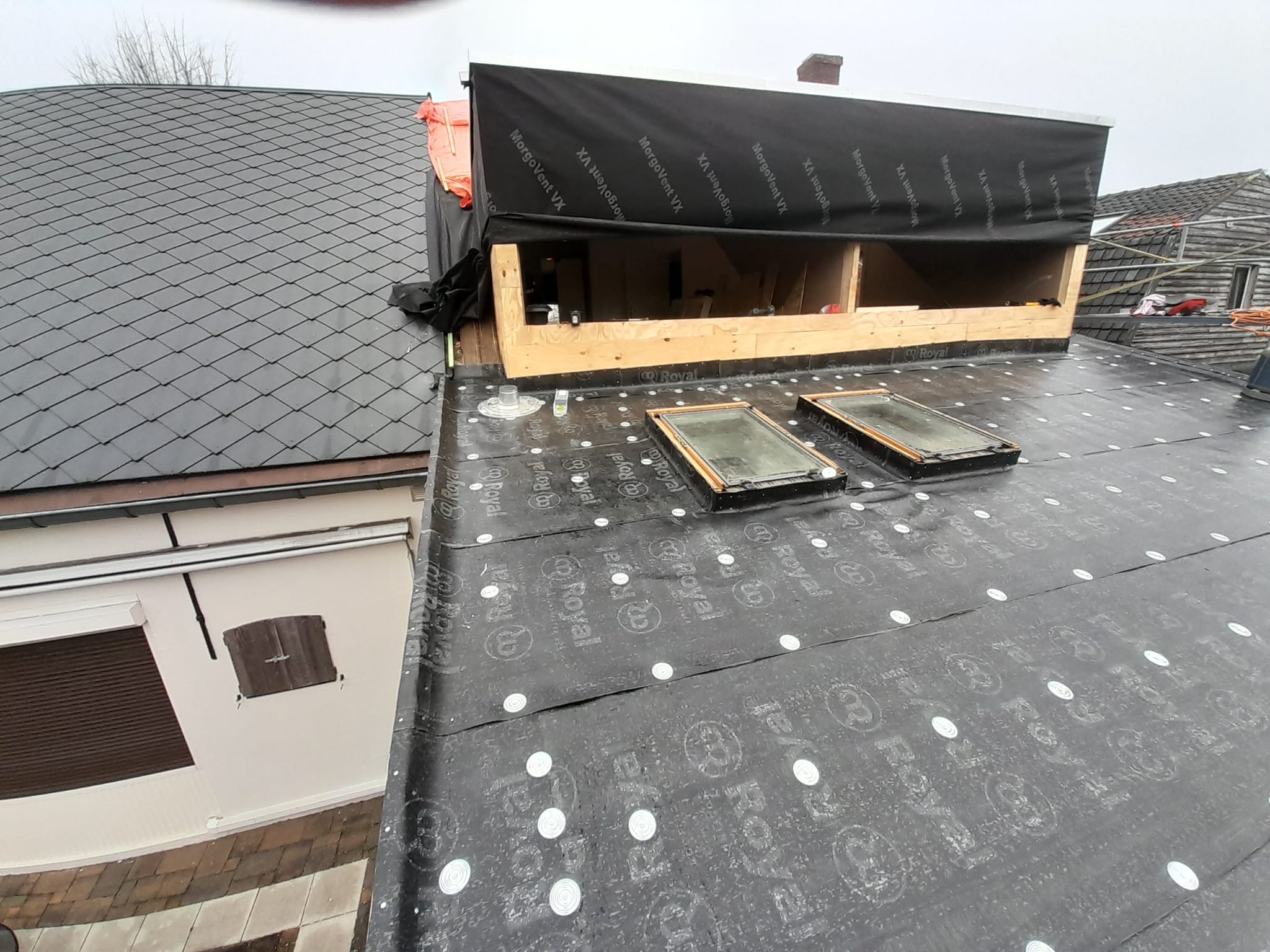
On the rear or side often yes, if it is no higher than 1.75 m, stays half a metre below the ridge and from the sides, has its underside 0.5 to 1 m above the eaves and a flat roof. On the front, never. In a protected townscape the exemption disappears. Our permit check runs your figures.
How high may my fence be?
Two metres in the back garden, one metre in the front garden, in front of the façade line. Higher is possible with a permit. Mind neighbour law: the boundary is shared, so agreeing with the neighbours saves you a procedure.
Which timber should I choose for decking in Amsterdam?
On a roof terrace hardwood or composite, because you do not want to be up there with a brush every year and weight per m² matters. In a shaded, damp garden hardwood or thermally modified timber; spruce is finished after eight years. Run it through our ten-year tool — you will see the cheapest timber is rarely the cheapest.
What does it cost if the floor joists are rotten?
Repairing a joist end with a steel shoe costs a few hundred euro per joist, replacing a whole joist two to three times that, and with a damp crawl space you are talking about the whole floor. We open one spot and measure the moisture; only then does a price go under it. Anyone quoting a total without opening up is guessing.
Can you supply the bespoke work without installing it?
Yes, with a clear agreement: we supply to size either from our own survey or from your dimensions. If you supply the dimensions, the measurement guarantee is yours. That is stated on the order.
Do you use your own people or hired labour?
A fixed core and a network of self-employed tradesmen we have worked with for years. You have one contact, and whoever turns up knows what was agreed.
What about dust and disruption?
We saw in the workshop or outdoors as much as possible. Indoors we use dust screens, extraction on the machine and floor covers. Swept clean every evening. For an owners' association we put a note in the entrance with the days and times.
Can I pay in instalments?
On jobs above € 2,500 we work with 30 % on order, 40 % at the start of installation and 30 % after handover. Below that, one invoice after handover. We never ask more than a third up front.
Do you do small jobs, like hanging one door?
Yes. Hanging one door is about an hour's work and it is in the price list. We try to bundle small jobs into one trip, which is cheaper for you too.
How soon can you start?
For small jobs usually within a week. For bespoke work it depends on production. If you are in a hurry there is a 35 % labour surcharge and we free someone up within five working days.
What happens to my data when I send the form?
Your request goes to our own system, to our WhatsApp and to info@toprenovatie.nl. We resell nothing to brokers. Within two working hours you get a reply from a person, not an automated acknowledgement.





 Google 5.0